5 SEO Tactics for Manufacturing Companies
As organic search drives over ten times more website traffic than social media, being visible in the search results is more important than ever. So here’s five SEO tactics for the manufacturing industry, to improve your visibility in search and be found by prospective customers.

(Photo by Clayton Cardinalli on Unsplash)
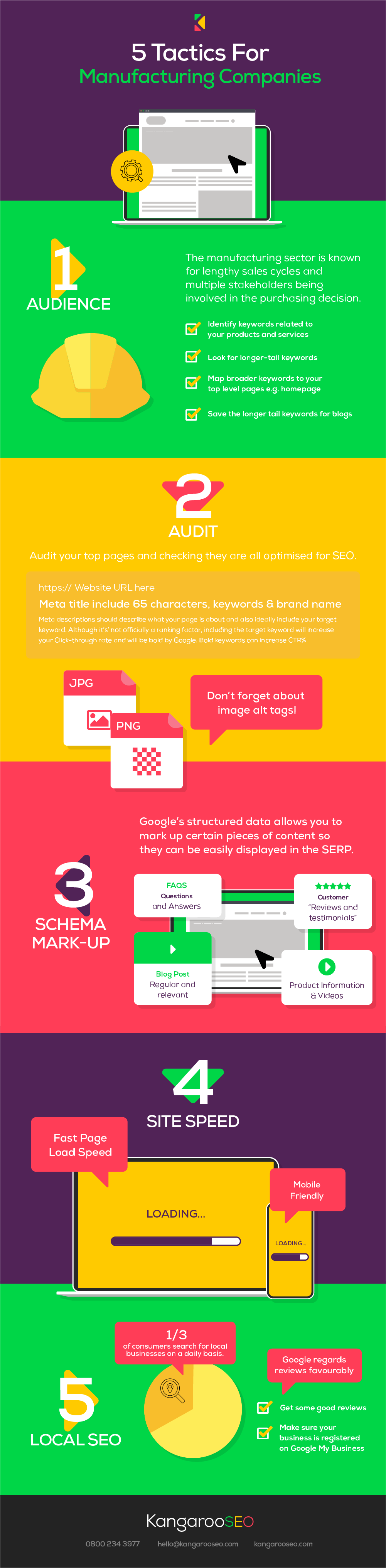
1. Identify your audience and their search intent
The first question you need to ask yourself, before starting any SEO strategy, is who do you want to be found by. The manufacturing sector is known for lengthy sales cycles and multiple stakeholders being involved in the purchasing decision. Therefore it’s essential to identify your target audience and understand how they will be searching for your products.
You can do this with good keyword research. Use the Google Ads Keyword Planning Tool to identify keywords related to your products and services. Look for longer-tail keywords that include questions like ‘what’ or ‘how’ as well as commercially driven keywords like ‘best … provider’ or ‘best … solution’. Then you can map broader keywords to your top level pages like your homepage, but save the longer tail keywords for blogs and product specific content.
Another great way to understand how your audience is searching for solutions is by taking a look at the search engine results page (SERP). If you type in a query, you’ll often see a ‘People Also Ask’ section which includes questions people have looked for in relation to your topic. This is a great way to get ideas for topics and subtopics to include in your content plan.
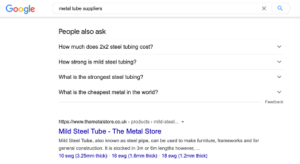
In the SERP you can also look at what Featured Snippets Google is displaying for your target query. If Google thinks a list of product features is useful, or deems a step-by-step guide of how a product works to be relevant, then try including these on some of your pages and see if your organic performance improves.
2. Audit your on page optimisation efforts
If you want to improve your visibility in the organic search results, you need to make sure you have the fundamentals down. This means auditing your top pages and checking they are all optimised for SEO.
The first thing to check is that your top pages have optimised meta titles and descriptions. Your meta titles should be no longer than 65 characters (to avoid truncation), should include your target keyword (preferably at the beginning) and include your brand name (preferably at the end). This will help users understand what your page is about, how it’s relevant to their search, and who you are.

An example of a truncated meta title
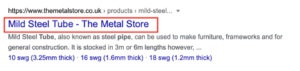
A non-truncated meta title
Every page should also have an optimised meta description. This is a short paragraph about your page that searchers will see in the search results. It should describe what your page is about and also ideally include your target keyword. Although it’s’ not officially a ranking factor, including the target keyword will increase your click-through rate and will be bolded by Google.
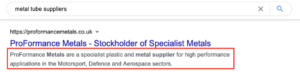
A meta description with keywords bolded, which can increase CTR%.
Every page should have a unique H1. This is your page’s headline and has a heavy weighting in terms of SEO for Google. So ensure your target keyword is included in your H1, and your headline gives a good overview of what the page is about. Other headers like H2s or H3s are a great place to include longer tail keywords and questions. Just beware of keyword stuffing – any and all content should always read naturally. Google penalises anything that sounds unnatural or overly repetitive.
When optimising your pages, don’t forget about image alt tags. Every image should ideally have a title, and an anchor text. This is a snippet of code that gives the image an alternative name. This is useful not only to Google, whose spiders can’t read images, but also to visually impaired users. Your image alt text should be a short description of what the image is and would ideally include a keyword, as this increases your chances of it being pulled into Google images.
3. Maximise schema mark-up
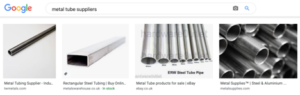
Google’s structured data allows you to mark up certain pieces of content so they can be easily displayed in the SERP. This helps you appear at the top of the search results and makes your content more visible to your prospective customers.
In the manufacturing industry, you can highlight content that will help your prospective buyers make a decision about your products and services. For example FAQs, reviews, articles, product information and product videos. All of these can be marked up with structured data to enhance your visibility in the SERP.
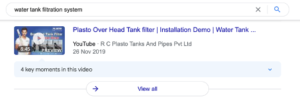
An extensive list of content types to mark up can be found on schema.org and there are plenty of free tools to help you create the code. If you’re unsure where to start, check out our guide of the 3 most useful schema markups for e-commerce.
4. Check your site speed and responsiveness
Getting customers to your site is one thing, but once they arrive on your website, you need to ensure they have a great user-experience. This means having well built pages that load fast, don’t move around, and show up on mobile.
There are a few ways to check your site speed, one of them being Google Lighthouse Tool in the Developer’s toolkit. This not only allows you to check how slow or fast a page takes to load, but it also gives you a list of recommendations and actions to improve your page speed.
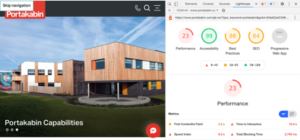
Google has also been progressively moving to mobile-first ranking since 2019, which means your site will be ranked based on how it performs on a mobile, rather than on desktop. So ensuring your site is responsive and mobile friendly is essential. And even if most B2B prospects convert on desktop, mobile is still overtaking desktop as the main platform for internet consumption in 2021, so make sure your content displays properly on a mobile, every button is accessible, and always test from a user perspective.
5. Don’t forget about local SEO tactics
Some companies in the industrial sector want to work with local businesses to save on shipping costs or to facilitate relationships between vendor and supplier. Add to this that almost a third of consumers search for local businesses on a daily basis. Therefore it’s essential that people in your area know that you exist, and local SEO tactics will help achieve this.
First of all make sure your business is registered on Google My Business, and that all the essential information is available (e.g. location, contact information, company speciality). All of this information will form your Business Profile, which also appears in Google’s Local Search results, Googles’ Knowledge Panel, and in Google Maps.
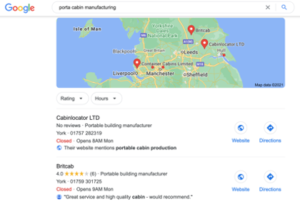
This is also a great occasion to get some good reviews, as prospective customers are more likely to convert if they see a review. So ask customers for reviews in person after you close a sale, schedule post-purchase emails and make sure to respond to existing reviews in a professional manner.
Google also regards reviews favourably – not only do they drive brand signals, boosting your domain authority, but they also give you credibility, which is a valuable ranking factor in Google’s algorithm.

So there you have some great tips to improve your organic performance. Don’t forget to track your changes and measure your rankings so see the results of your hard work. If you would like an extra hand, please reach out to one of our SEO specialists.
Contact our Wakefield based team on 0800 234 3977
Struggling to Get Your Site Ranking? Get in Touch. Need Help Boosting Your Authority? Read on...