What is a backlink profile and why is it important for SEO?
Backlinks are still considered one of the top ranking factors in Google’s page indexing algorithm, but link building is one of the most requested tasks for digital agencies as companies are unsure how to go about getting more links. So in this blog we’re going to explain what backlinks are, why they’re important and how you can improve your backlink profile.
What is a backlink in SEO?
In simple terms, a backlink is a link from another site or another page, to your site. Any time another page or an external website links users to your content, this is considered a backlink. Your collection of external backlinks is known as your backlink profile.
Google values the quality of links: for example if a reputable site, like a government website, university, or official establishment in your industry, links to you, this is considered as a positive thing. This demonstrates that they see your content as authoritative and trustworthy. The same goes for reputable sites in your industry linking to you; relevance is hugely important when it comes to backlinks. However if a spammy, irrelevant or unreliable site links to your site, this will be considered as a negative thing in the eyes of search engines.
Why are backlinks important?
Backlinks are essentially votes from other websites, signaling that your content is credible, valuable and trustworthy. The more ‘votes’ you receive, the more authority your site has in the eyes of search engines. Backlinks are a known ranking factor for SEO. This means that Google will evaluate the quality and quantity of backlinks your site receives as part of its algorithm, which is used to rank pages in the search engines results page (SERP).
Over the past few years, as Google has rolled out algorithm updates, the nature of how Google evaluates backlinks has changed. In the past, websites with lots of backlinks, even if they were from untrustworthy sites, were still appearing top in the SERP. But with algorithm updates like the Penguin update in 2012, Google started to penalize websites that had unnatural amounts of backlinks.
High quality backlinks can improve a websites’ organic performance, and spammy backlinks from toxic domains can have a negative impact on your SEO performance. Therefore it’s important to go after a few good quality links rather than trying to get a high number of low quality links. Quality over quantity is the rule of thumb for SEO.
How to get more backlinks?
There are a few methods for getting good quality backlinks which we’ve outlined below, but just remember that old methods like adding links to your website in forum comment boxes or creating ‘link-farm’ web pages is now considered bad practice.
- Register your site to any relevant online directories
This may be one of the quickest and easiest ways to increase your backlinks: by registering your website to online directories like Yelp or Google My Business, you’re adding valuable links your way. And at the same time, you’re making users aware of your website on multiple platforms, like Google Maps.
- Identify influencers and get them to share your content
Now when we say ‘influencers’, we don’t just mean instagram stars. We mean bloggers, blogs, websites, podcasters, writers, reviewers – anyone who has authority in your industry is a potential influencer. You should create an outreach programme where you contact all of these people in your list, and ask them if they would either share a post that you have written, or create a piece of content around your products/service and link to you. Although this takes time, the results can be very rewarding, and as the old saying goes, if you don’t ask, you won’t get. So go and ask!
- Create some ‘how-to’ content
How-to content, in the form of posts, blogs, infographics or videos is one of the most widely shared and linked-to types of content. If you can identify some topics that would be relevant for your site, create them and promote them as much as possible on your social media platforms.
How to monitor backlinks?
In order to stay on top of your backlink profile, there are various tools at your disposal. These include: Google Search Console, Ahrefs and SEMRush.
Most of these tools have dashboards that allow you to see the number of referring domains, the number of backlinks and your site’s authority score. This is the score created by the tool based on the quality and quality of backlinks your domain is receiving. While this score isn’t used directly by Google and is not a direct ranking factor, it still provides a good indication of how authoritative your site is considered to be.
Some tools also let you see the link anchor text that is being used, so you can evaluate what words and phrases other sites are using when they’re linking to yours.
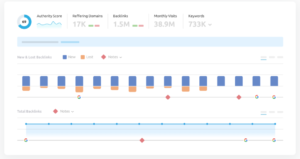
Source: SEMRush
We’d recommend doing backlink profile audits at least every quarter, to monitor the number of spammy or toxic domains that are linking to your site.
Once you’ve identified a list of toxic domains, Google Search Console has a handy tool that allows you to disavow certain domains. This means that you’re expressly telling Google that you don’t want these domains linking to your website, so Google will ignore them going forward.
The disavow tool should be used with great caution, however, as you may find yourself harming your site if it’s used incorrectly. Only links which are putting you at risk of a manual penalty should be disavowed – maybe your site has been targeted by link spammers or someone previously has purchased low-quality backlinks en-masse.
You can also directly reach out to webmasters and ask them to remove your links from their site. If they don’t agree to do this, or they don’t respond, you can then escalate to Google.
So either way you can keep your backlink profile clean, and keep your SEO performance on track. If you would like any additional support with your backlink profile or your linking strategy, just reach out and one of our SEO experts can give you a hand.
Contact our Yorkshire based team on 0800 234 3977
Struggling to Get Your Site Ranking? Get in Touch. Need Help Boosting Your Authority? Read on...