Internal linking is a great way to improve your on-site SEO, and one that is often forgotten by marketers who instead prioritise improving their external backlink profile. So here’s our quick guide on how to get your internal linking right.
What is internal linking?
According to Moz, Internal Links are “hyperlinks that point at (target) the same domain as the domain that the link exists on (source).” This essentially means a page on your website that points to another page on your website. Both users (humans) and search engines (bots) use internal links to navigate through your website.
There are a few different types of links to be aware of:
- Navigation links: these are the most common and you will see these in most menu bars at the top or side of websites. There are valuable and visible internal links.
- Homepage links: another powerful place to link from is the homepage. The homepage should be used to link to some of your top, valuable pages.
- Internal content links: you may link to other pages on your website within a paragraph of content. This is quite common and a useful way to guide users to other pages without them leaving your site. A great place to use this is when referencing related content, e.g. related blog pages or product pages.
Why are internal links important for SEO?
Internal links are important for SEO for a few reasons:
- They help users and bots to find their way around your website. Internal links are especially helpful if you want to guide a user on a journey throughout your site, helping them go to specific pages and complete actions on these pages.
- Internal links help establish a hierarchy between pages. By having internal links you can create and add value to the pages by assigning them with the most internal links, and less to other less valuable pages. If a page gets a lot of internal links, this is a signal to Google that this page must be important.
- Internal links spread link juice / link equity around pages. If Google ranks one of your pages well in the search results, and considers this page as being valuable to users, some of that power is passed on to other pages that it links to. So if page A is considered strong, some of that strength will be passed on to page B when it links to it.
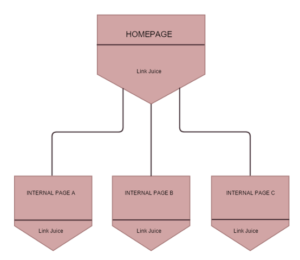
This diagram illustrates how link juice/ link value is passed on between internal links
(source: https://www.hallaminternet.com/internal-links-seo/)
What should your internal linking strategy be?
1. Link to your most important pages as often as you can
If you have pages that need a boost, look for other relevant pages on your site that could link to them. Also consider whether they are important enough to be linked to from the homepage, however be wary of not adding too many links from your homepage as this could be overwhelming from a user perspective.
2. Use good anchor tags
When linking to a page on your site, be sure to use a keyworded anchor tag, what is relevant to the page. This will send a signal to Google bots about what the page on the link is about, as well as to users. Avoid bland anchor tags like ‘this blog’ or ‘this product’ and use detailed, descriptive anchor tags.
3. Audit your pages for unimportant links
You may have a few repeating internal links on your website near the top of the page, like: download our guide, or apply for our job posting. However these links aren’t great for your SEO strategy, and if they’re repeated on multiple occasions throughout the site, remove the ones that are not needed and only have them in strategic places.
4. Remove any factors that could make your pages look spammy
A penalty factor is something that you’re doing on your site that Google sees as negative for users. A prime example of this is duplicate content. Websites that have duplicate content is a penalty factor and will lead Google to devaluing some of your pages. You should avoid internal links to pages with duplicate content, or where over 50% of the on page content is the same as another page. Also avoid internally linking to pages with thin content – this will also be seen as a bad use of linkage for users.
Conclusion:
Auditing your internal links and improving your link flow across your website is a great opportunity to increase the strength of your pages and improve your overall organic performance. By improving your links and removing risks, you should quickly see the rewards. If you would like help with improving your internal link strategy, reach out to one of our team today.