How to approach SEO as a construction or trades company
Nowadays every type of industry has moved online – including tradesmen and construction companies. But SEO can be a scary word for marketers in the construction industry who are used to referrals by word of mouth or more traditional marketing. That’s why we’ve put together a guide of what to do if you’re a construction or trades company looking to improve your organic visibility in the digital landscape.

1. Check you’re showing the right content
‘Construction company’ or ‘builders uk’ are very popular search terms and ranking for these keywords can be difficult. But if you want to make your services visible to your target audience, there’s some essential groundwork to do to help your website rank for your ideal search terms.
Keyword research and using your niche
Making a list of target keywords and mapping them to your content is the first and primary step of any SEO strategy. You need to look up keywords and their search volumes to find out how people are searching for your services in Google. There are lots of free tools on the market that help with keyword suggestions like Ubersuggest and Answer the Public. There are also paid tools like SEMRush, Ahrefs and keyword.io which can offer a more comprehensive keywords list.
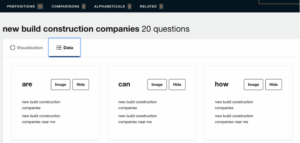
Answer the public gives you keyword phrase suggestions based on a seed keyword
If you specialise in a niche, for example the restoration of old buildings, make sure you highlight this and use keywords that are relevant to that specific niche. You can even look for longer tail keywords like ‘commercial office construction companies Manchester’ if you want to appear for those targeted searches. More often, the longer the keyword phrase, the less competition you will have.
Create service pages
Once you’ve defined your list of top keywords, you need to decide which pages to assign them to. Each page should target a different primary keyword. If you offer a range of different construction services, you should make a page for each one, explain what the involves, highlight benefits, and make sure you mention the target keyword in the H1 (page title), the meta title and description (the page title and description that appear in Google) and mention it across the text but in a natural way. Avoid overstuffing the text with the keyword as Google could penalise you for this.
2. Make sure your site is technically sound
Before you start bringing traffic to your construction website, you should make sure your site itself is user-friendly and technically functional. All your pages should be accessible, there should be no broken links and if you have an out-dated page, it should be redirected to the newest version.
Indexation
In order to crawl your website and display it in the search results, search engines need your web pages to be indexable. You can check this by using a tool like Google Search Console, where you can check the indexation status of all your webpages. If you want it to rank, it needs to be indexed.
Another quick way to check which pages of your site are being indexed is to enter “site:” then your domain name, for example: “site:kangarooseo.co.uk/” into a search engine. This will show you all the URLs indexed by Google or Bing under your domain, as well as the meta titles and descriptions it’s found for each page.
You can help search engines crawl your website and index your pages by submitting an XML sitemap, which is a list of all of the pages on your site that you want to be viewed by the search engine. It’s recommended to re-submit your sitemap every time you make any big changes to your site like adding new web pages, updating meta content or making structural changes to the site.
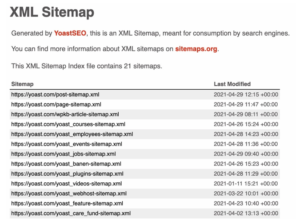
Image source: https://yoast.com/what-is-an-xml-sitemap-and-why-should-you-have-one/
Site speed
Users are less and less patient when it comes to page load speed times – so having a website that is fast is essential. As people navigate through your service pages, request a quote, or click on a ‘contact-us’ button, you should be making sure everything loads quickly to avoid high bounce-rates.
To do this you should first test your page load speed – there are many free tools available on the web for this – then if you notice any that are especially slow, you should get a developer to check the technical aspects. This could include removing render-blocking javascript, using a content delivery network (CDN) and reducing redirects. There are also a number of ‘quick wins’ to be made to improve site speed, like ensuring all of the imagery on your site is properly sized and compressed.
Most page speed testing tools like Lighthouse and Google’s page load speed will give you feedback on any issues and steps to improve them.
Mobile-friendliness
Mobile searches are on the rise vs. desktop searches, and most customers are likely to be searching on the go, or from a mobile device at home. This means your site should be fully responsive in it’s design, but also fully accessible to a mobile user. Especially important are ensuring your ‘call us’ button can trigger a phone call directly, and that a ‘contact us’ button will create an email. Also important are clear lead-generation forms – so if you have a ‘get a quote’ form, make sure it’s easy to fill-out from a mobile, and that there is no strange formatting or buttons hidden.
The best way to test this is by going on your website from a mobile – go through the motions as if you were a customer, and highlight any issues like page loading times, strange formatting, or difficulty navigating across the site. This will help you identify potential user experience issues that you should address both for your SEO performance and your conversion rates.
3. Make sure people know where you are
Knowledge Panels & Local SEO
Knowledge panels are information boxes that appear in Google Search Results when people search for entities like people, organisations and brands. A knowledge panel is a great way to increase customer trust in your company as well as increase your brand visibility in the SERP.
You can both search for and claim your knowledge panel in Google, and update it with the correct information. To do this by first of all searching for your construction company and click ‘share’ and copy the URL. Then go to ‘claim knowledge panel’ at the bottom of the panel, then click ‘get verified’. This should trigger a form, which you should fill out and submit.
You can also claim local knowledge panels by signing up to Google My Business. Once you have an account on here you can verify and update all of the information relevant to your business, including address, contact number, opening hours, on site parking availability, social media links and more.
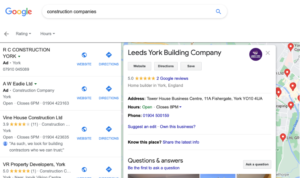
Backlinks
Backlinks are links from external websites to your own. They will help you build your domain authority – this means your trustworthiness in the eyes of the search engine, which will have a positive impact on your rankings. In order to get links from other sites to yours, you can actively ask for them. If you make a list of construction or trades websites, blogs and communities, you can email the webmaster, and tell them about your site and ask them if you would be willing to mention you somewhere. This might feel like a punt in the dark, but a solid link building campaign is one of the best ways to get authentic, high-value backlinks.
You can also offer yourself as an expert source on any stories which might be relevant to your industry. A great way to find opportunities is via the hashtag #journorequest on Twitter, where reporters and journalists look for sources to comment on stories they are writing.
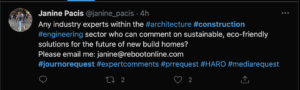
Another great way for trades businesses to get backlinks is to register across a range of directories. Just make sure that you are consistent with your information (e.g. company name, address, contact number, website) across all directories. This is also another great signal to Google that you are a well-established and trustworthy business. When it comes to directories, just make sure that they are established (e.g. not link farms) and relevant to your industry.
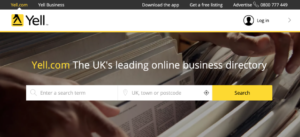
Yell.com is a good example of a construction company directory
So there you have some key SEO practices to consider as a construction company looking to improve your organic performance. And remember that search engine optimisation is an ongoing practice, so get your website in good shape, then maintain your standards to see the best results.
Contact our Yorkshire based team on 0800 234 3977.
Struggling to Get Your Site Ranking? Get in Touch. Need Help Boosting Your Authority? Read on...