Internal Links
Everything you need to know about internal linking.
It isn’t some big industry secret that links are key to SEO. Getting good quality backlinks feeding into your site to improve its authority is absolutely fundamental to getting your website ranking well.
But, what if we were to tell you that external links were only half the battle and that internal links played a key role in making use of all that lovely authority?
What Are Internal Links?
Internal links are those links that sit within your website and go from page to page (as opposed to an external link that links to a webpage outside of your website. More on this later.)
There are two kinds of internal links, each with its own properties:
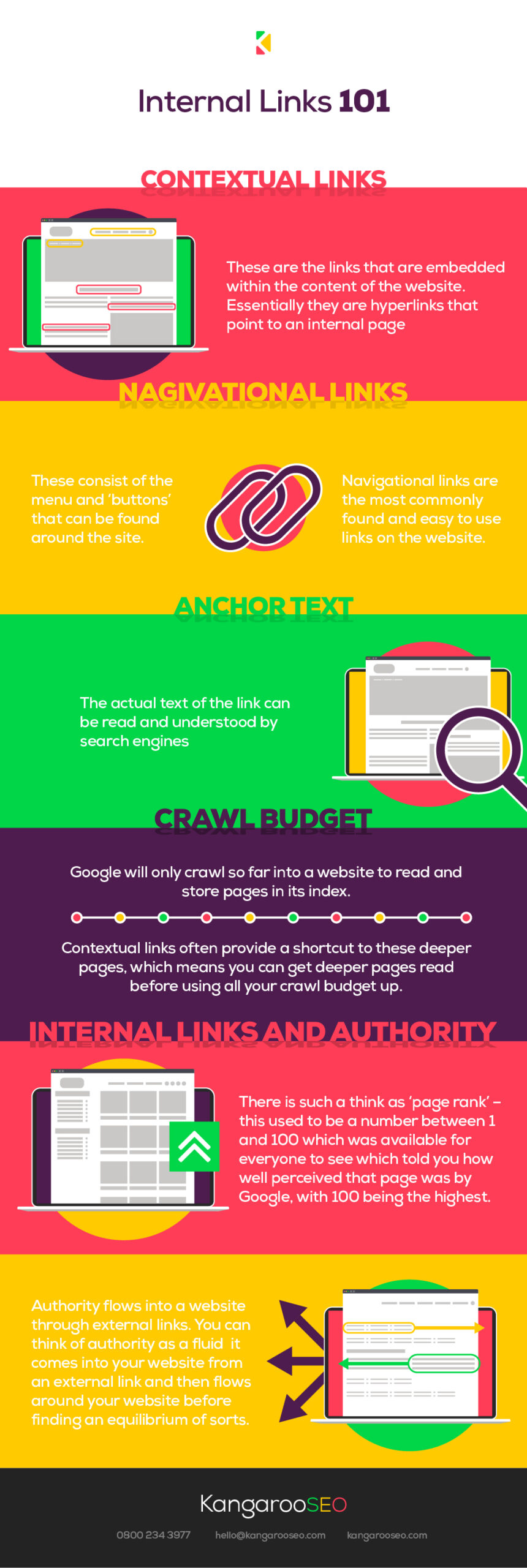
- Contextual links – these are the links that are embedded within the content of the website. Essentially they are hyperlinks that point to an internal page.
- Navigational links – these consist of the menu and ‘buttons’ that can be found around the site. These buttons are often part of the design of the site. An example of this would be the service icons on the homepage of this website.
Navigational links are the most commonly found and easy to use links on the website. As they consist of the main menu, as well as large buttons or icons with clear instructions on, they are typically what a user engages with most. But, despite this, contextual links have several advantages over navigational links.
A Bit More on Contextual Links
There are two reasons why contextual links are just as, if not more important than navigational links with regards to SEO.
- Anchor text: the actual text of the link can be read and understood by search engines. If a link says ‘SEO Services’ and links to a page about SEO Services, then it sends very clear signals to Google as to the subject of a landing page. If the text and landing page are not related than it sends very confusing signals to search engines, but if they are related then it bolsters the relevancy of the landing page a touch.
- Crawl budget: crawl budget is a big subject and likely deserves a post unto itself. But in brief – Google will only crawl so far into a website to read and store pages in its index. It would simply take too long and impact it’s usability if it had to crawl every single page on the internet, therefore how deep Google will go into a website is limited. If Google bots are only crawling a site through its navigational links then it has to adhere to every step in the chain, and so pages which take 6, 7, 8 etc. clicks to reach risk simply not being found. But contextual links often provide a shortcut to these deeper pages, which means you can get deeper pages read before using all your crawl budget up.
There is a huge addendum to all of this – Google simply wants to provide the best user experience possible. A well thought out internal linking profile should simply be part of providing a good user experience, which by extension will also help you rank better. There is absolutely such a thing as going overboard with internal linking, and stuffing keywords into the anchor text of contextual links. Keep it natural and think about the user first, and you can’t go far wrong.
Internal links and Authority
There is also another factor to consider when talking about internal links – authority. There is such a think as ‘page rank’ – this used to be a number between 1 and 100 which was available for everyone to see which told you how well perceived that page was by Google, with 100 being the highest.
Page rank is key to ranking and while the figure is not necessarily visible any more, it is very much a thing and most SEO work is simply based around increasing that number. Another term for page rank which is often used interchangeably is authority. If a website has more authority it is perceived as being better and thus may rank higher, to put it very simply.
Authority flows into a website through external links. You can think of authority as a fluid (which is why SEOs love to sit around a pint giggling to themselves calling it ‘link juice’ when nobody is looking…), it comes into your website from an external link and then flows around your website before finding an equilibrium of sorts.
If your website has poor internal linking then you risk the authority not reaching deeper pages into the website, and thus your key service or product pages may struggle to rank. Most external links, in reality, will point at your home page. In theory, if your homepage had zero internal links pointing out of it, contextual or navigational, then zero authority would reach the sub-pages and they would struggle to rank at all.
Knowing this, we can use contextual links to ensure that authority is flowing exactly where we want it to, to give key pages a boost and help them to rank.
Contact our West Yorkshire based team on 0800 234 3977
Struggling to Get Your Site Ranking? Get in Touch. Need Help Boosting Your Authority? Read on...