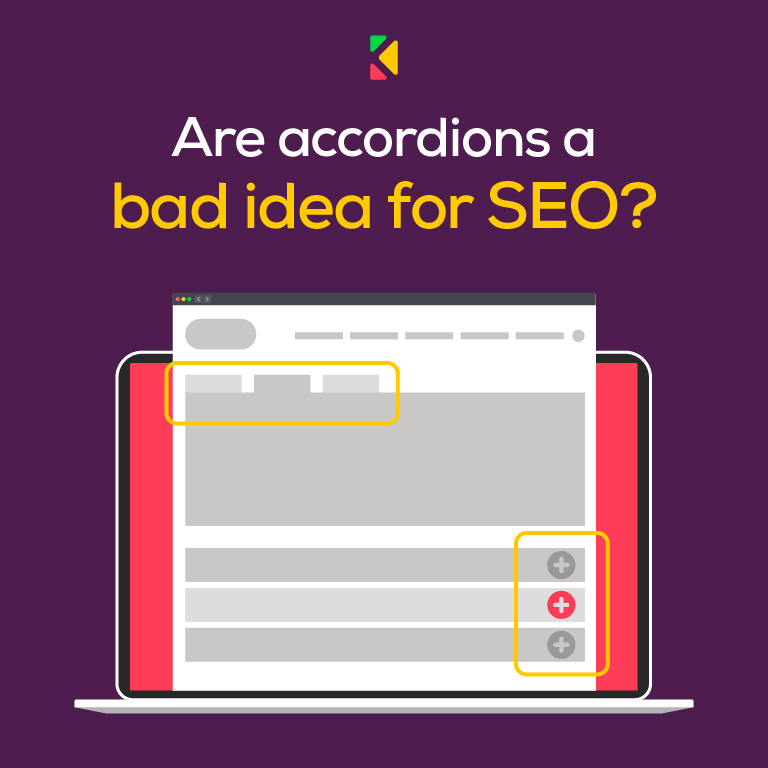
Are accordions a bad idea for SEO?
Accordions are a great way to organise content on a web page. However there is a lot of confusion around whether accordion content can negatively affect your SEO performance. In this blog, we’ll look at what accordions are, why they’re popular, and whether they are a bad idea if you want to get your pages to rank.
What are accordions and how are they used?
An accordion is a way to organise content on a web page, often in the form of tabs that can be clicked through by the user. Accordions allow you to categorise your content into sections, with sections that can be hidden and revealed based on a user’s click. They create a user-friendly way to access the content in digestible sections.
Tabbed content is popular because it gives web developers and web designers a way to store a lot of information on a page, without having to list it all in one go, which may be overwhelming to users. Accordions are also popular as they can allow for a more design-led page, with interactive elements to animations which make the page more fun to interact with than a long page of only text.
FAQ pages are a common area to see accordion content, as the web owner might want to categorise their frequently asked questions into categories if they have a large amount to display on the page.
Below is an example of a website that uses accordions on its FAQs page:
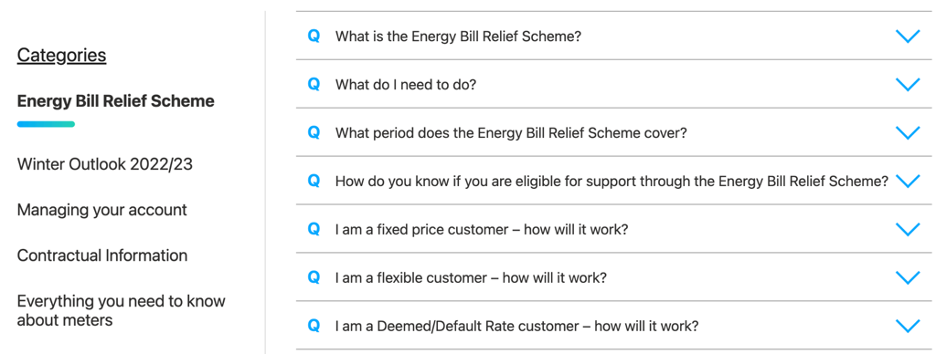
Source: https://www.engie.co.uk/help-and-support/faqs
How do accordions work?
Accordions are essentially menus that display a set of headers and when you click on each one, it will reveal additional information. In a page template, the content that is behind the accordion will still be part of the HTML code of the page. There will just be some functionality (javascript or CSS) that will trigger the content to be hidden or revealed.
Accordion tabbed content can be directly linked to from other pages – for example if you have a page with an accordion menu on it, and you want to link directly to a section on the accordion, you can do this with anchor tags.
An anchor tag will allow you to label the accordion headers, and then with an anchor tag assigned to each one, you can link directly to these by adding them at the end of a URL. For example your page might be: https://www.engie.co.uk/help-and-support/faqs
But you could tab to an accordion section on this page by going to: https://www.engie.co.uk/help-and-support/faqs#complaints
Are accordions bad for SEO?
The reason people worry about whether having accordion content is good or bad for SEO is because the content is hidden. So does this mean Google can still see it? Well in short, yes. The thing to understand about when Google bots crawl your content is that Google reads all content on your page, and understands tags. Google however can’t see images, infographics or web page design. It can only see your content. So whether your content is hidden behind an accordion menu or not, as long as the content is in the HTML code of the page, it will be crawled by spiders and therefore read by the search engine.
This means that the same rules for SEO optimisation that apply to normal body content also apply to accordion content. You should make sure you use header tags (H2s, H3s etc…) consistently and in order or priority, and you should use descriptive anchor tags for your internal links.
In terms of linking to your tabbed content, the anchor will be added to the end of the URL. So this will be considered a normal internal link on your site, and you will give the page value by linking to it.
When to use accordions?
Now although Google can crawl your content, when deciding whether to use accordions or tabs, you should always think about what’s best for the user. In a whiteboard Friday session, Moz.com said that content behind accordion content generally performs worse than when the content is taken out of the accordion and added to the page. This may be due to the fact that users like to scroll, and the action of having to click on different sections could put people off reading the additional content. Users are more likely to engage with content on the page directly and not behind a tab or a drop down.
So it all depends on what content you’re planning to put behind a tab, and how much value it will be to the user to see it directly on the page. If you have lots of dry content, it may be helpful to have a nicely designed accordion that breaks up your content into sections. However we would recommend to always keep your most important content directly on the page and not to put it behind a tab that a user would have to click on.
If you would like some advice about how to optimise your web pages and get the most out of your content, check out our on page optimisation services, or you can reach out to speak to one of our SEO specialists.