How to find low hanging fruit opportunities?
When planning your SEO strategy, there will be long term goals, but there are also short-term opportunities where you may be able to do some small optimisations to quickly boost your SEO performance. These are called low hanging fruit. We’re going to show you how to find them and what to do with them.
How to find low hanging fruit opportunities?
From page 2 to page 1 opportunities
To find low hanging fruit opportunities, you should look at keywords where you are already ranking, but could be improved. You will need to look at a range of factors.
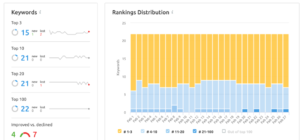
To start, you should use an SEO tool like SEMRush, that can show you your current rankings for a set of target keywords. SEMRush, for example, will show you how many keywords you have in positions 1 to 3, 3 to 10, 11 to 20 and over position 20.
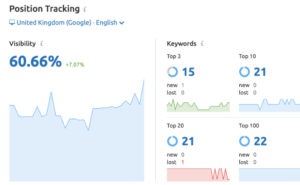
(source: SEMRush)
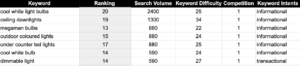
The low hanging fruit opportunities tend to sit where you rank between positions 10 and 20 in Google, meaning you could be on page 2 but with a bit of work, could move to page 1. You should first filter the keywords to only include ones where you are ranking lower than position 10 but higher than position 20. Then you should check the search volume and the difficulty score. Make sure the search volume is high enough that you think it is worth putting work into. For example if the search volume is 0, it may not be worth trying to optimise for.
Once you have your list of filtered keywords, you will now have a list of keyword opportunities.
Featured snippet opportunities
Another way to find keyword low hanging fruit is to look to win featured snippets. As defined by Search Metrics, “featured snippets are highlighted excerpts of text that appear at the top of a Google search results page in what is known as ‘Position 0’. They provide users with a quick answer to their search query.” They can be in the format of text boxes showing snippets of text from a web page, they can be in the format of videos, infographics, People always ask questions and more.
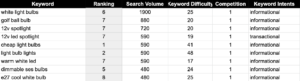
As a general rule, in order to be featured in a Featured snippet spot, the page that features the piece of content you want to show in the snippet, should already be ranking on page 1 of Google, so in positions 1 to 10. We would advise you to use this opportunity to add featured snippet worthy content to any pages on page 1, but lower than position 2. You should use a keyword tracking tool to identify any keywords for which your site is ranking in positions 3 to 10.
As you did for the low hanging fruit keywords on page 2, make a list of these keywords, your average ranking position, the search volume, difficulty score and the keyword intent (if this is provided).
So now you’ve found your keywords, what do you do with them to improve rankings?
How to optimise for low hanging fruit opportunities?
For the keywords where you are currently ranking in positions 10 to 20, you should now check your web pages and make sure that you are adhering to SEO best practice.
For your target keywords, make sure that you are optimising the Meta data (title and description), H1s, H2s, body content and alt tags.
Note that Google has moved from a keyword-centric approach to entities and topics. Therefore make sure that your content is talking about entities related to your primary keyword. Use of related entities across the content will vastly improve your ranking abilities.
For the keywords where you are looking to win the featured snippet, the approach here is slightly different. Google already judges that your content includes enough relevant entities and the correct use of keywords in the text. What you need to do here is understand what Google deems most useful to users when they are searching for the target keyword. The best way to do this is to type into Google your target keyword, and check if there already is a featured snippet in the search results. Nine times out of ten there will be.
The key is to understand what information Google is showing, and what the website that is currently in the featured snippet, is doing right. Then you should tailor your content to do this too.
How to track performance of low hanging fruit opportunities?
A lot about SEO is testing and learning. In order to track how your optimisation work is performing, you should add your target keywords to a ranking report. In the example we used earlier, SEMRush allows you to add an unlimited number of keywords to a ranking report, and will show you every month how you are performing, comparing to the previous period.
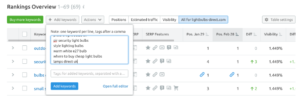
This tool also lets you see the rankings distribution of all your keywords, and where you have gained and lost rankings. This is useful for long term monitoring of your target keywords.
So low hanging fruit opportunities are worth spending some time on as a little bit of work can often equate to great results. And if you’re a new site, going for these keywords is worth investing time in, whilst you build your domain authority, which you’ll need for more competitive and broad keywords.
If you would like help with optimisation work, or finding your low hanging fruit opportunities, speak to one of our specialists today.