What is a ranking report and how to build one
When it comes to building your SEO strategy, a ranking report can be your best friend as it allows you to monitor your websites’ performance for your target keywords, and it helps assess if your SEO efforts are having a positive impact.
What does a ranking report involve?
A ranking report involves tracking in which position your web pages appear in the search engine results page, for the keywords you’ve optimised them for. It is often a list of keywords and keyphrases that includes search volume, difficulty score, search intent and most importantly, average ranking position.
How can ranking reports help you?
A ranking report allows you to keep track, month over month, of how your pages are performing, and how your rankings are changing. For example, if you see a drop in positions for your target keyword, this may mean that your page isn’t as relevant as it could be or that a competitor is ranking better than you in the search results. If your web page is climbing in the search results, then your optimisation efforts are paying off.
Trends in your ranking reports can give you insights on how Google is evaluating your content, and can highlight opportunities for improvements. They are a great tool for monthly optimisation recommendations.
How should you set up a ranking report?
1. Identify your target keywords
The first step in setting up your ranking report is to select a set of keywords that you want to track. Ideally your ranking report shouldn’t contain more than 5 keywords per topic, and over 100 keywords overall. Within each topic you should include variations of your target keywords e.g.
Topic: ‘student mortgage’
Keywords:
- Student mortgage
- Best student mortgages
- How to get a student mortgage
Even better, you could group keywords so you would have average rankings for a group of keywords. This approach helps to highlight larger trends that would be missed on a word to word level.
2. Decide on your goals
You should decide on where you’d like your rankings to be ideally so you have something to work towards. Setting benchmarks will help you prioritise where you put your efforts.
3. Agree on the timeframe
When it comes to reporting, a month by month timeline is the optimal time frame. However some people prefer weekly reports. It is worth noting that although month on month is the most popular timeframe for reporting, rankings in Google can fluctuate. So it’s best to analyse trends rather than simply comparing one month to another. Also small fluctuations from 1 to 3 positions are expected. If it jumps from 5+ positions that should be inspected e.g. look at the page, look at competitors and look at the search results for that term.
Some helpful tools
There are a few different SEO tools that can automate the ranking reports for you. SEMRush’s position tracking report is a user-friendly way to set up your ranking report.
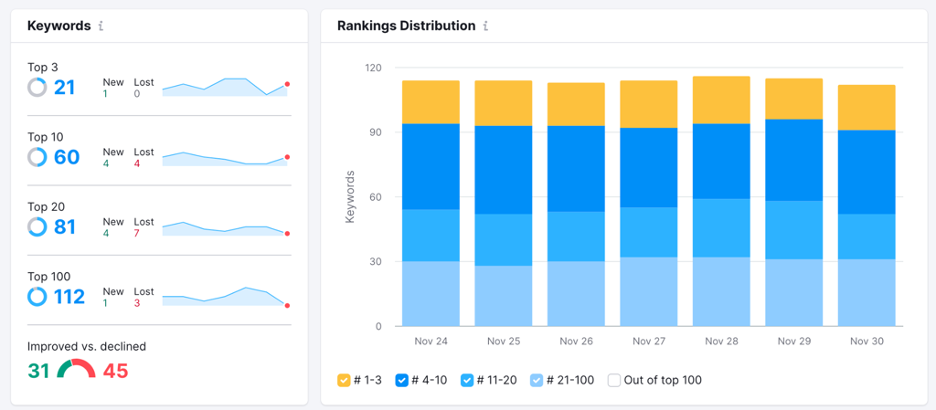 In this report you can make a list of your target keywords, then the tool will show you which pages are ranking for those keywords, with a comparison to the previous month. It will also show you your rankings distribution, so you can compare your spread of keywords across the search results pages.
Another great tool is the Landing page report by Advance web rankings.
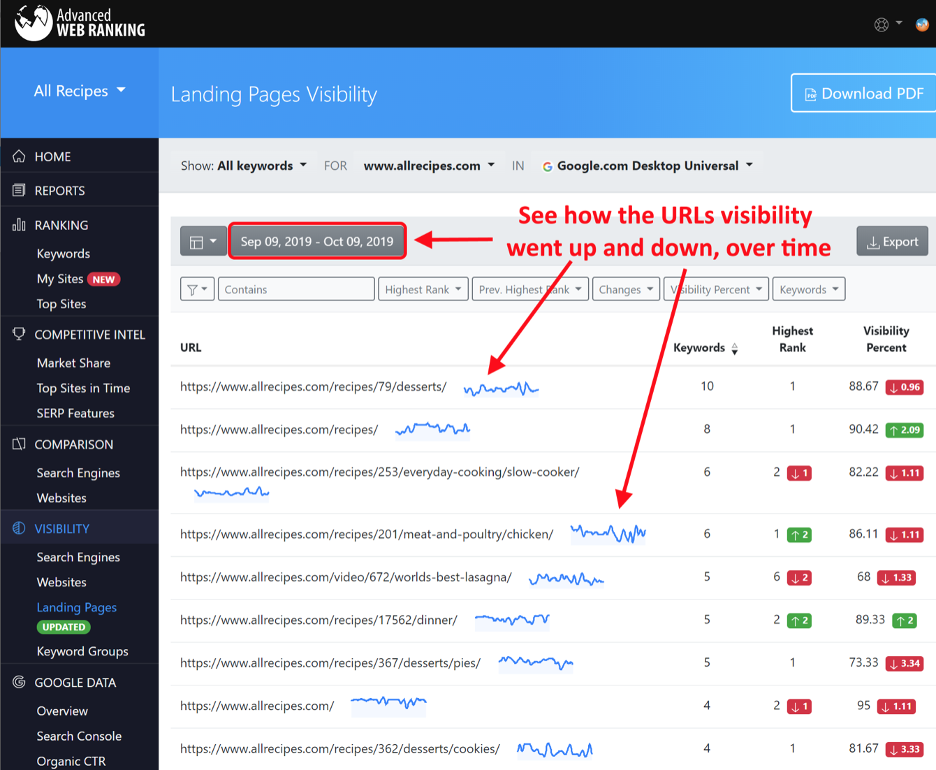 Example of the landing page report by Advance web rankings
The SEO tool SpyFu also offers an automated ranking report to track your position in the SERP. Similar to the other tools SpyFu lets you create a list and build on that, monitoring month over month. Another great feature of this tool is that it allows you to group keywords, which makes it easier to spot trends over time.
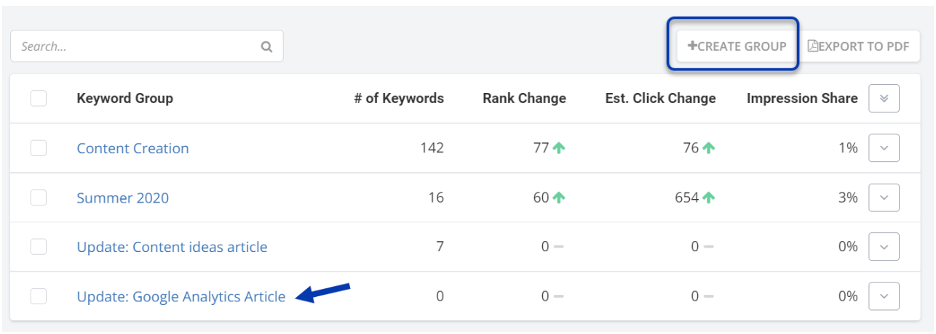
https://help.spyfu.com/en/articles/6455173-take-the-worry-out-of-content-updates
If you would like help in setting up rankings reports, identifying which keywords to target or help identifying optimisation opportunities, check out our services or reach out to one of our team.