(image source: https://unsplash.com/photos/jLwVAUtLOAQ)
What SEO elements are important for content writers?
I’m sure you’ve all heard that ‘content is king’, and that great content is an important part of a successful SEO strategy. This is true, but it doesn’t mean that your content writers should be completely clueless about SEO. In fact, the more a content writer understands about SEO, the better their content will be, both for the sers and for the search engines. So we’ve put together a quick SEO 101 for your copywriters, to ensure everyone is on the same (SEO friendly) page.
Meta content
In most places, your copywriters will also be writing your meta content, so making sure they understand what this is and what it’s used for is important.
The meta content of your page are tags in your HTML document source code that define certain sections of text. Metadata will not be displayed on your page but will be read by machines (e.g. the search engines and they’re crawling spiders). Metadata is used by browsers to display the name of your page at the top of your internet tab and by search engines to display information about your webpage to users searching the web.
Title tags
Your meta title (title tag) is the title of your page as you would like it to be displayed in the search results. This is also the text you’ll see at the top of your browser. Search engines see this as the ‘title’ of your page (not to be confused with your H1). The standard best practice for title tags is that they will include your primary keyword (near the beginning), and aptly describe what your page is about. It is also common to mention your brand/company name at the end. It is recommended to keep title tags around or below 69 characters as if longer, Google may truncate the text in the search results.
Here’s some good title tags for vegan cupcake toppings:
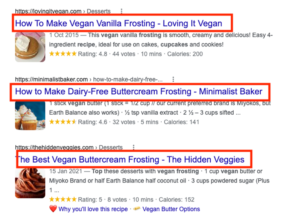
Meta titles have been considered as a ranking factor in the past and Google has recently said that they are now displaying 87% of meta titles in the search results. If you don’t explicitly give your page a meta title, Google will select one from a section of the page, so if you can optimise yours, we would recommend doing so. Google’s own guidance on title tags can be found here.
Meta descriptions
Although meta descriptions haven’t been expressly defined as a ranking factor, their value cannot be underestimated. Meta descriptions are the short paragraphs that show on the search results under your page title, and are used by searchers to understand if your page is going to help them find what they’re looking for. Therefore a well written meta description will have an impact on your click through rate.
A well written meta description should give searchers a view of what they can expect to find on your page – it should be descriptive and easy to read. Although it doesn’t need to contain your primary keyword, Google has been known to bold keywords in meta descriptions that it thinks will be relevant to the search.
There is no maximum length, but descriptions can be truncated around 160-180 characters, so we would advise to keep them under this length.
Here are some good examples of meta descriptions ranking on page 1 for surveyors on Leeds:


Headers
Headers, specifically your H1 are a valuable SEO element of a page. Your H1 is your main headline on the page that users will see when they start reading. From a content perspective, it’s important that this main header summarises the page. Like a human would, Google’s search engine spiders will also read this H1 to understand what the page is about. That’s why it’s recommended to include your primary target keyword in the main header, as this will strengthen the link between this keyword and your piece of content.
There is no hard and fast rule about how long a H1 should be, but too long and users might get confused, and too short and you’re not adding much description about the page. So most headers tend to be around the 40 to 80 characters window.
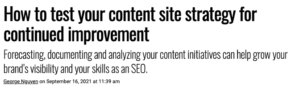
Example of a good H1:
Your pieces of content should contain other headers as well, to break up the text and help the user understand the different sections. For example H2, H3, H4 and so in until you have a fully structured page. From an SEO perspective, H2s and other sub-headers are a great way to include longer-tail keywords like ‘why’ and ‘how’ questions. But just make sure that the content in that specific subsection relates to its header. Google doesn’t like to be duped and can detect irrelevant copy or keyword stuffing.
Copy and overstuffing
Speaking of which – irrelevant copy and keyword stuffing should be avoided at all costs. The key to writing good copy for search engines, is to write good copy for users. This can get confusing for copywriters if they are given a list of keywords to insert into a text.
Although it is good practice to include some primary and secondary keywords throughout the copy, the idea is that it should always read naturally. If you read a section and feel like a word is unnecessarily included, then remove it.
Google’s algorithm has become smarter over the years and can recognise when something doesn’t sound right. Google has also learnt to penalise copy if the header, or meta content, is completely different to the copy on the page. So make sure your body content is relevant, reads naturally and brings value to the user.
Image alt text
Our final point for copywriters is to understand the importance of image alt tags. Image alt text provides context to what an image is showing. As search engine crawlers can’t read images, they rely on these alt text tags to understand what an image is showing. Therefore we recommend including an alt text tag in the code for every image you display on your website, that includes a description of what that image is.
For example your image alt text might look like this:
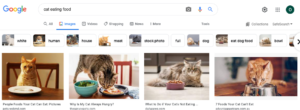
<img src=”catimage1.png” alt=”Cat eating food”>
Adding alt tags to your images may also increase your chances of appearing in the ‘image’ search results. If someone is searching for an image of something that is closely related to how you described your image on your page, Google may pull up your image into the results. This is especially valuable for things like infographics and guides.
So there we have all the important SEO considerations for your copywriter to be aware of when creating copy for your website. If your team needs additional support or training, you can reach out to one of our SEO consultants today.